Power and feed
Record commanded power, cutting speed, acceleration behavior, and any corner or small-feature override.
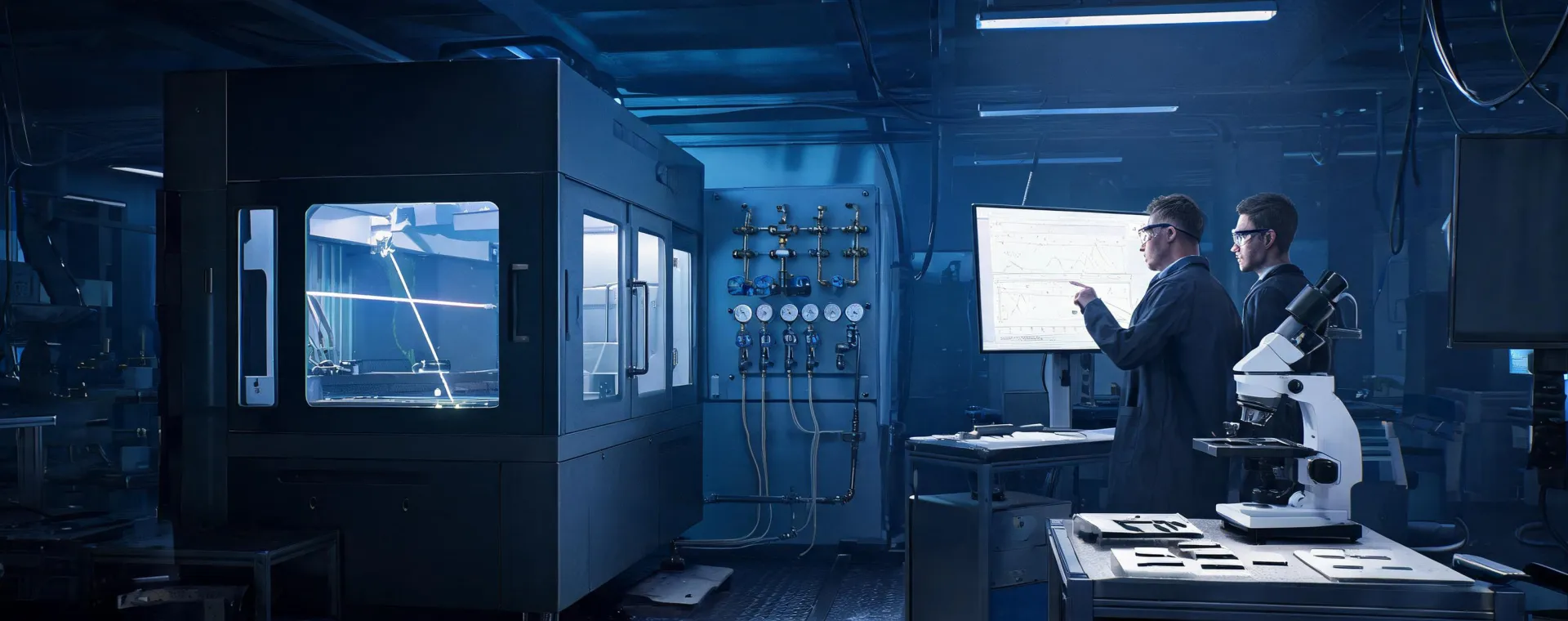
Source power is only one input. Focus position, beam delivery, nozzle centering, gas chemistry, pressure, pierce strategy, feed, acceleration, material state, and thermal accumulation interact. A technical comparison is credible when these inputs and the resulting edge observations are recorded together.
These are measurement channels, not published Amada model claims. Values belong to the tested configuration and should travel with the drawing revision and sample record.
Record commanded power, cutting speed, acceleration behavior, and any corner or small-feature override.
State focus reference, lens and protective-window condition, nozzle diameter, stand-off, and centering check.
Name assist gas, delivered purity, dynamic pressure or flow method, piping condition, and supply stability.
Capture grade, nominal and measured thickness, coating or film, flatness, heat or lot reference, and surface condition.
Include pierce type, hole-to-thickness ratio, corner radii, lead-ins, contour density, and nest thermal sequence.
Inspect dross, burr, kerf, taper, striation or roughness, heat tint, feature size, and the complete cell cycle.
Regional release, options, and revision status matter. The inquiry route below requests the current controlled document rather than serving an unverified universal file.
Working envelope, source configuration, utilities, mass, interfaces, guarding, and selected automation options.
Drawing, material, consumable, gas, focus, cut condition, inspection, cycle boundary, and approval fields.
Guarding, interlocks, extraction, utilities, access, responsibilities, training, and local conformity inputs.
Named test parts, sample quantity, measurement equipment, cycle definition, pass criteria, and exception handling.
Approve drawing revisions, representative material lots, inspection definitions, annual mix, utilities, cell interfaces, and the economic timing boundary. A laser-on time alone is not a cell-cycle definition.
Record machine configuration, software revision, source, optics, nozzle, gas, material, ambient condition, program, and operator. Run repeated samples so a single favorable part does not define capability.
Use calibrated instruments and named methods for feature size, taper, burr or dross, roughness, heat tint, and cycle time. Photograph edge and pierce conditions with sample identification.
Document where the released condition stops: another grade, thicker sheet, different coating, reduced gas purity, worn optics, altered nesting, or a new unload rule can change the result.
Assign who can change cut conditions, how revisions are approved, which alarms or inspection trends trigger containment, and when a controlled re-trial is mandatory.
Higher power can increase available energy and expand some process windows, but it can also raise capital, utility, gas, extraction, and thermal-management demands. Aggressive feed can improve nominal throughput while tightening corner and small-feature margins. Nitrogen can support oxide-free edges on suitable material but may add gas cost and supply constraints; oxygen can change cut speed and edge chemistry. Unattended automation can extend productive hours, yet sheet separation, unload collisions, remnant behavior, and downstream queues become controlling risks.
Provide three representative part classes, the material and gas records, the inspection rule, and a complete-cycle boundary. The output can be reviewed without hiding application limits.