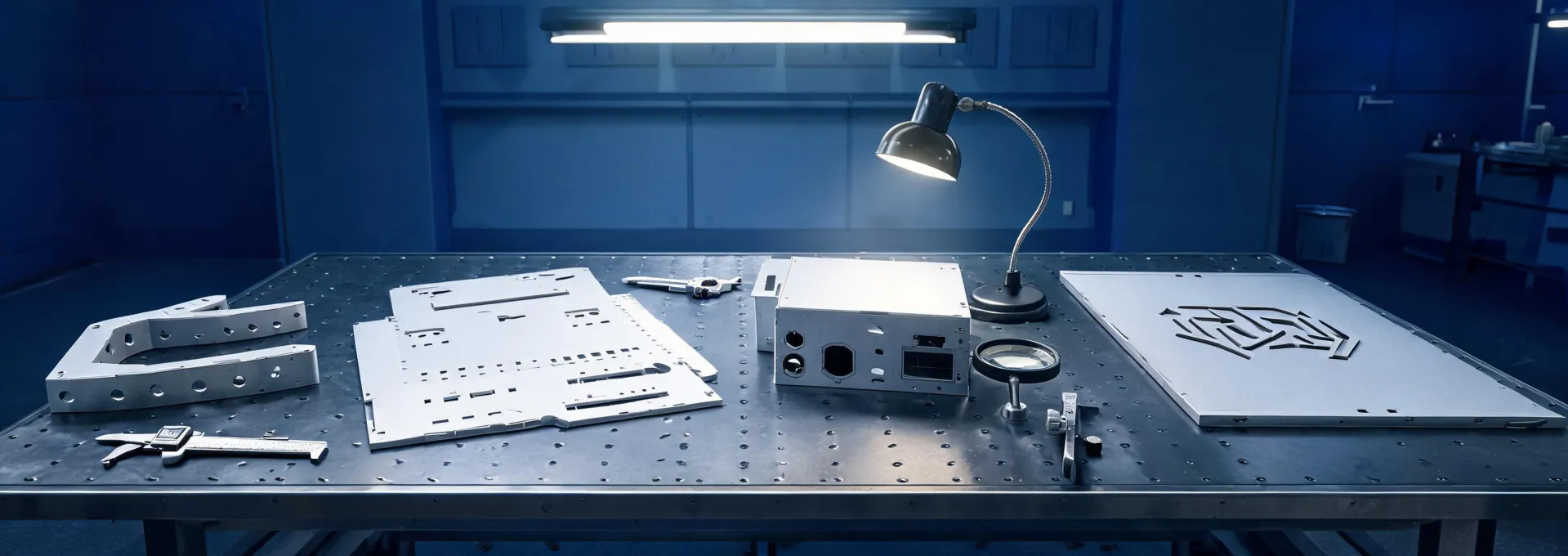
Laser-cut components for multiple industries
Application constraints first

Amada laser applications mapped to material, geometry, and release criteria

Industry labels do not select a machine. The part family, inspection method, downstream operations, traceability obligations, and production cadence determine which laser process and automation boundary deserve a trial.

Icon grid

Four production environments, four different acceptance conversations

Each example states a common pressure and the evidence needed to avoid a generic equipment match.

SM

Sheet-metal fabrication

Mixed grades, short runs, frequent nesting changes, and variable downstream capacity make schedule response as important as peak cutting speed.

Check:

Representative nest cycle, remnant rules, changeover, burr limit, and bending queue.

AU

Automotive components

Revision control, repeat fixtures, traceability, and repeatable feature quality matter when cut blanks feed welded or formed assemblies.

Check:

Part revision, material lot, hole geometry, edge acceptance, sample size, and capability method.

AE

Aerospace fabrication

Material value, heat-affected behavior, contamination control, and documentation can outweigh simple throughput comparisons.

Check:

Approved material condition, process qualification path, inspection plan, and customer-specific restrictions.

EN

Enclosures and signage

Thin sheet, visible edges, dense contours, small holes, films, and rapid order variation require controlled piercing and careful handling.

Check:

Surface protection, corner quality, film response, scratch risk, sorting, and cosmetic release criteria.

Technical requirements comparison

Method trade-offs that should remain visible

The table is a selection framework, not a universal ranking. Actual performance must be reproduced on the buyer's material, geometry, utilities, consumables, and inspection method.

Decision factorFiber-laser routeCO2-laser routeAcceptance evidence
Thin-sheet productivityOften selected for high traverse and conversion efficiency, subject to part geometry and handling.May remain viable in established cells with qualified conditions and trained maintenance.Same drawing, sheet lot, gas record, full cycle, and edge inspection.
Reflective metalsMaterial-specific source and process suitability must be confirmed; reflection risk is not eliminated by a label.Suitability depends on wavelength interaction, machine design, and validated procedure.Supplier-approved material trial with documented protective limits.
Thicker materialPower, focus, nozzle, gas, pierce stability, and thermal accumulation can shift the useful window.Established cut conditions may satisfy specific edge expectations but carry different utility and maintenance economics.Cross-section, taper, dross, roughness, heat tint, and repeated pierces.
Cell economicsSource efficiency is one input; automation, consumables, gas, uptime, and downstream queues affect realized cost.Installed experience and sunk infrastructure can matter, while maintenance and energy profiles require current costing.Cost model with stated utilization, utility tariff, service scope, and bottleneck assumptions.

Known boundaries

Laser cutting does not remove the need to manage flatness, coatings, gas purity, optics condition, fume extraction, guarding, and downstream burr or heat-tint criteria. Small-feature quality can conflict with aggressive speed settings. Automation can raise unattended capacity while adding sheet-separation, collision, sorting, and buffer constraints. High nominal power may not improve a cycle dominated by piercing, exchange, or material handling.

Build the application matrix

Compare parts and processes under one declared test plan

Select representative easy, typical, and difficult parts; define material lots, inspection points, and timing boundaries; then compare routes without changing the acceptance rules mid-trial.